It is not just the channel itself. Data, relevance and timing make all the difference. In this blog, we walk you through the most important email marketing trends for 2026 and what they mean for organisations in the travel and leisure industry.
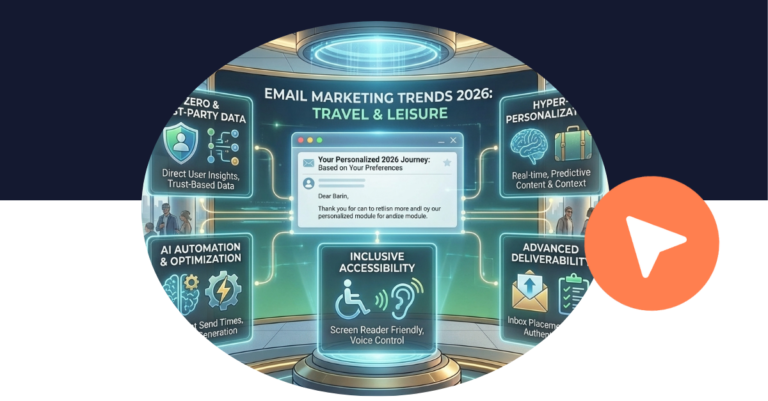
Zero- and first-party data
With third-party cookies on their way out and stricter GDPR regulations, the use of zero- and first-party data is becoming increasingly important. Zero-party data is information a customer shares voluntarily, for example by filling in a preferences form. First-party data is collected through your own channels based on behaviour: email clicks, previous bookings, and so on.
Research shows that 69% of people are fine with their data being used to optimise their experience. However, it is important to be transparent about what information you collect and what you intend to use that data for.
There are various ways to collect this data. What matters most is that it is enjoyable for the recipient and useful for you. One example of how we have done this before: a Christmas campaign in collaboration with De Kennemer Duincampings. Read the case study here.
Hyper-personalisation
By now, this is barely a trend anymore. Personalisation has always been relevant and will continue to be so. However, with the rise of AI combined with first-party data, there are increasingly more opportunities to take this to the next level.
Think of personalisation based on booking behaviour, interests, but also the time of dispatch. With predictive AI, all of this can be tailored to the individual with ever-greater precision.
From email channel to data-driven communication strategy
Email is becoming less and less of a stand-alone channel. By 2026, email will be part of a broader communication strategy built around your database. Alongside email, channels like:
SMS
WhatsApp
On-site personalisation
are increasingly being driven from the same data source. Email remains the foundation, but it is no longer the only touchpoint. For every message, think about the right channel at the right moment, and avoid sending similar content to the same person across multiple channels at once.
AI
As we touched on earlier, AI goes beyond writing subject lines and other content. By 2026, predictive AI will be increasingly used to segment target audiences and predict future booking and/or travel behaviour.
AI is also already widely used for content generation such as subject lines, images and translations, and that is only set to grow.
A common challenge for travel and leisure companies is simply not having enough content for all their different target audiences, and not having the time to create it. This is where AI comes in. By working with AI agents like ChatGPT or Gemini, you can train AI to write in a way that resonates with your target audience. Ultimately, this saves a significant amount of time when creating content.
The same goes for visual content. Of course you want to show people real photos, but with AI, you can create beautiful atmospheric images based on existing photos. A couple of examples:
You want to promote the autumn season, but your only photo shoot took place in summer. With Google’s Nano Banana, you can upload an existing photo and ask it to give the image an autumnal feel. The original photo stays intact and is simply restyled to match the season you want to promote.
Your photo shoot happened on a day when the weather did not cooperate. With AI, you can now easily make the sun shine.
Mobile focus and accessibility
More than half of users now open emails on mobile. Naturally, the design focus is shifting towards a mobile-first approach. Minimalist designs that focus on a single specific action are preferred over more complex designs that can cause display issues on mobile. When writing code for your email (template), a mobile-first approach is also increasingly favoured over a desktop-first one.
There is also growing attention to dark mode, and accessibility is no longer optional. Now that the European Accessibility Act (EAA) is in force, it is a must-have, not a nice-to-have. Any email template containing essential information around payments or stays must be accessible to everyone. Make sure you test your emails across different devices.
Deliverability and database hygiene become standard practice
In 2026, deliverability is no longer a technical afterthought, but an integral part of email marketing. In November 2025, Gmail announced that it would be monitoring this even more strictly than before. Break the rules, and your emails are less likely to reach the inbox. Consider:
Active removal of inactive contacts
Engagement-based segmentation
Monitoring your sending reputation
Checking your email’s technical performance
A healthy database leads to better results and lower costs. In practice: make database hygiene a recurring process, not a one-off task.