The benefits of AI translations: save time on newsletter creation
Background and challenge
We see this quite often in the travel and leisure sector: organisations have guests from several countries, but send emails in just one or two languages. The ambition to send emails in multiple languages is there, but the time isn’t. In practice, adding an extra language means rebuilding the entire email from scratch in your email platform. Filling in each text block separately, adjusting every CTA, changing links and checking UTM tags. And then you have to test everything all over again.
The big question for many marketing managers:how do you send out newsletters in multiple languages without spending a lot more time on it?
The solution: AI translations
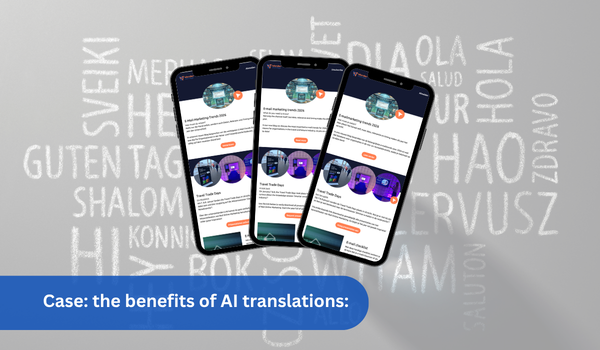
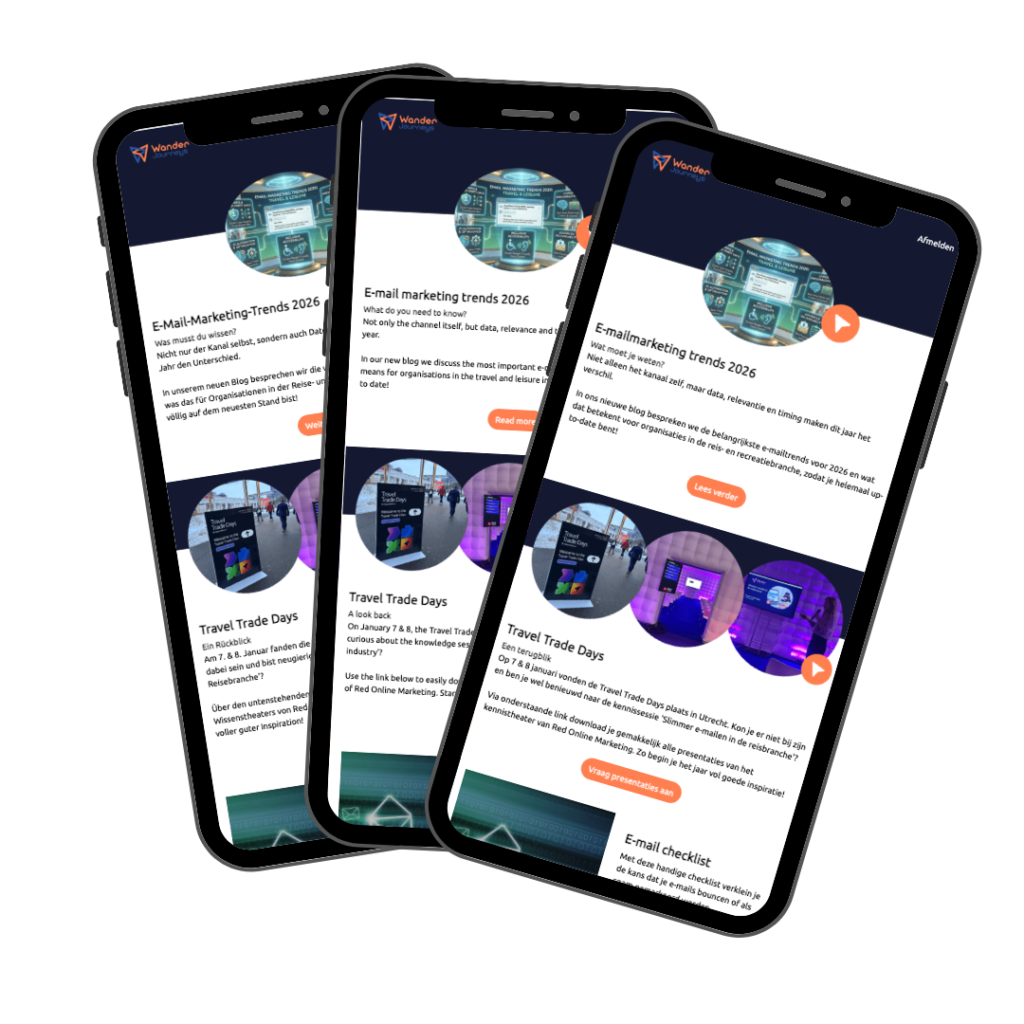
With AI translations from Wander Journeys, you only need to create your newsletter in one language. By default, this is in Dutch. Here’s how it works:
- Create your newsletters in the source language. Layout, blocks, links and CTAs: get them right the first time.
- Click the translate button.You’ll create a copy of your Dutch email and change the language. The translated text appears immediately in the correct place within the layout..
- Make any necessary adjustments. Use the edit button to change a translation or set the URLs to the correct language version.
The biggest benefit is that the translation is carried out directly within the system. You no longer need to copy texts, translate them and then copy them back into a new email.
All you need to do is check the translation and update the URLs to point to the correct language version.
Your writing style, even in the translation
Every organisation has its own writing style. We set this out in the prompt that generates the translations.
For example, you can specify that German guests should always be addressed as ‘Sie’, even if the Dutch text uses the informal form. In the same way, you can provide guidelines for accommodation types or park names that must not be translated. Any changes made during the proofreading process are then incorporated back into the instructions. This improves the quality of the translation and shortens your proofreading time.
The right message for each market
A German guest is not a Dutch guest who reads German. The travel distance is different, school holidays are at different times, and they prioritise different things. An offer that works best in the Netherlands might not work at all in Germany. Because your newsletter consists of separate content blocks, you can tailor exactly what’s needed for each language version:
- You can resolve minor differences by editing the text within an existing block.
- Need a completely new block? Simply add that block. The rest of the email remains unchanged.
- Another example of social proof: Reviews from your own market work better than translated reviews from another country.
Swapping blocks takes just a few minutes. That’s exactly where the benefit lies: the same newsletter, with the right message for each target group.
The results
Before we started using AI translations, we tracked how much time it actually takes to format a newsletter. In this example, we’ve used an average of 2.5 hours for the Dutch newsletter. Each additional language you add manually takes an average of one and a half hours.*
With AI translations, that same additional language takes just 30 minutes. That’s more than half the time. And that applies to every language you add. See the calculation below:
- Sending in 2 languages with AI translations: approx. 25% time saving per mailing
- Sending in 3 languages with AI translations: approx. 35% time saving per mailing
- Sending in 4 languages with AI translations: approx. 40% time saving per mailing
*The estimated time is an example. The actual time required to create newsletters manually varies per client.
All the benefits of AI translations:
- Reach more markets without your budget increasing in line with the number of languages.
- The right message for each market, rather than a single translated compromise.
- Room for optimisation rather than production.
- Scalable: moving from three to four languages takes only a fraction of the extra time.
Would you like to find out what AI translations can do for your organisation? Get in touch with us!